








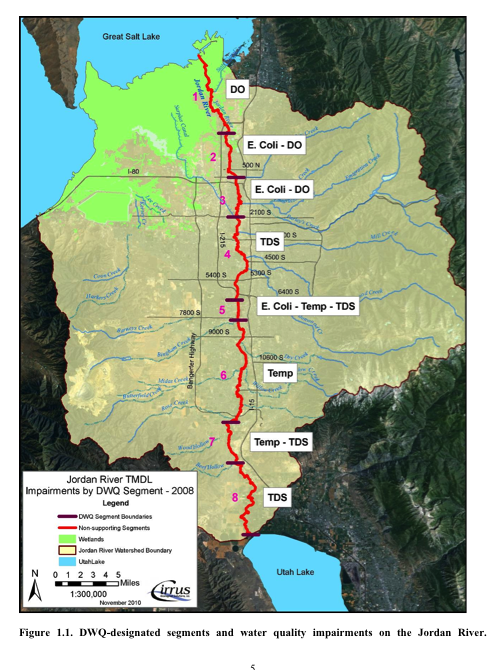
This water quality study for the Jordan River establishes the Total Maximum Daily Load (TMDL) for Total Organic Matter (OM) of 3,983 kg/day that will achieve the model endpoint for Dissolved Oxygen (DO). This target concentration is defined in a water quality model (QUAL2Kw) which is being used as a decision support tool for restoring beneficial use to the lower Jordan River. Additional testing was conducted to quantify uncertainty of input parameters and rates used in the calibrated model. Based on these results and additional information reviewed during the TMDL process, a 1.0 mg/L implicit Margin of Safety (MOS) was added to the Jordan River instantaneous DO standard of 4.5 mg/L. Input concentrations of Total OM that resulted in meeting the model endpoint of 5.5 mg/L DO were used to define permissible loads to the lower Jordan River. This model endpoint and the resulting permissible loads account for levels of uncertainty that exist in the TMDL process at this time and are designed to maintain DO levels in the lower Jordan River above the instantaneous DO standard.
View this complete post...Posts Tagged ‘Jordan River’
Jordan River Water Quality Study
Wednesday, January 4th, 2012JORDAN RIVER BASIN: PLANNING FOR THE FUTURE
Wednesday, March 10th, 2010UTAH DIVISION OF WATER RESOURCES
In order to meet all the future water demands in the Jordan River Basin, cooperative efforts will be needed to more fully and efficiently use existing water supplies. State and local leaders must work closely with water
suppliers in the Basin to continue to promote aggressive water conservation measures and additional innovative water management technologies. While this effort may delay the need for costly new water developments, these measures alone will not satisfy all future needs. The proposed Bear River Development Project will ultimately be needed. Exactly when this project will be constructed depends upon actual population growth as well as the ability of water conservation and other strategies to reduce water demand and the agreements within the basin to share resources.
Follow InfrastructureUSA
CATEGORIES
- Accountability (49)
- Aging Infrastructure (260)
- Aviation (25)
- Biking (75)
- Bipartisan (135)
- Bridges (151)
- Broadband (17)
- Buses (58)
- Carbon Tax (10)
- Clean Air (58)
- Climate Change (34)
- Competitiveness (114)
- Congestion (146)
- Dams (28)
- Democrat (64)
- Drinking Water (41)
- Economic Stimulus (94)
- Employment (100)
- Energy (141)
- Environment (149)
- Equity (70)
- Funding (273)
- Global (37)
- Great American Infrastructure (2)
- Green (113)
- Hazardous Waste (13)
- High Speed Rail (129)
- Highway (239)
- Inland Waterways (53)
- Jobs (131)
- Land Use (53)
- LEED (9)
- Levees (19)
- Local (451)
- National (516)
- Policy (348)
- Pollution (61)
- Private Investment (53)
- Public Opinion (66)
- Public Parks & Recreation (38)
- Public Transportation (308)
- Racism (6)
- Rail (203)
- Recession (57)
- Recovery (160)
- Republican (50)
- Roads (325)
- Schools (30)
- Seaports (20)
- Smart Grid (33)
- Smart Growth (172)
- Solid Waste (10)
- Sustainability (164)
- Tax (61)
- Technology (76)
- Telecommunications (12)
- Transit (427)
- Urban Planning (269)
- Wastewater (37)
- Water Treatment (30)
Video, stills and tales. Share images of the Infra in your community that demands attention. Post your ideas about national Infra issues. Go ahead. Show Us Your Infra! Upload and instantly share your message.
Is the administration moving fast enough on Infra issues? Are Americans prepared to pay more taxes for repairs? Should job creation be the guiding determination? Vote now!
What do the experts think? This is where the nation's public policy organizations, trade associations and think tanks weigh in with analysis on Infra issues. Tell them what you think. Ask questions. Share a different view.
The Infra Blog offers cutting edge perspective on a broad spectrum of Infra topics. Frequent updates and provocative posts highlight hot button topics -- essential ingredients of a national Infra dialogue.


RSS Feed